Fall is in the air and that means... Pumpkin Season!
Pumpkins are a warm-season vining crop that come in an amazing variety of shapes, sizes, and colors. While most pumpkins take about 80–120 days to reach harvest, the actual time to maturity depends on the specific cultivar as well as temperature and weather conditions. Each cultivar has its own characteristics and is bred for a specific purpose. One of the most common types of pumpkins is the Jack o’ lantern. The cultivars are bred primarily for carving and decorating. While they make great Jack o’ lanterns, they tend to be less appealing for eating, often tasting bland or stringy. So, how do you know how to choose the right Jack o’ lantern cultivar to grow in your garden?
Think about what characteristics you would like in your pumpkin.
What color would you like? Traditional bright orange? Yellow? White? Or perhaps a more unusual brownish color?
What shape do you like? Pumpkins can be oblong, oval, pear shaped, and many others.
What size are you looking for? There are big, medium (great for Jack o’ lanterns), small, and even mini pumpkins.
If growing your own, when do you want to harvest? Different cultivars have different estimated days to maturity, so check the seed packet for the estimated time to harvest. However, even with that expected date, the actual date to harvest can change depending on environmental conditions.
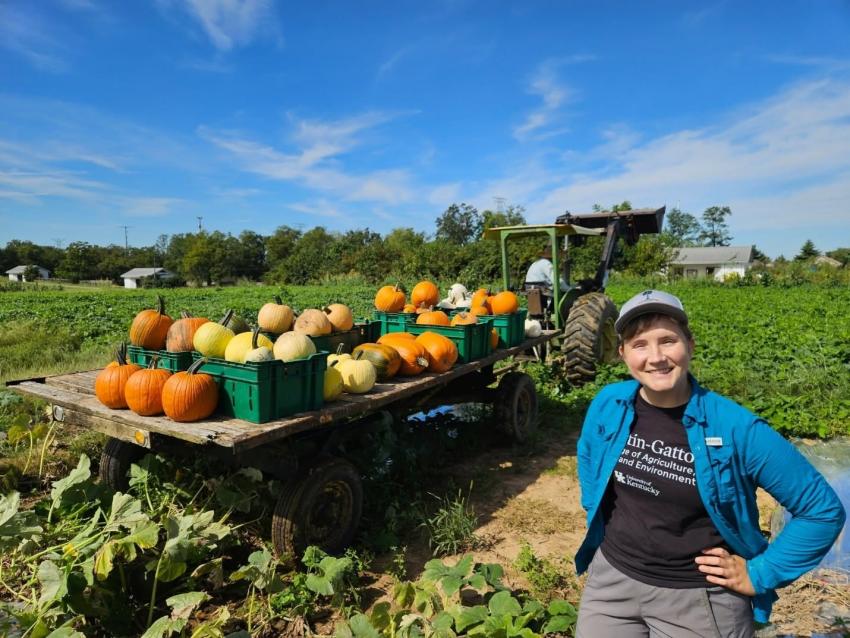
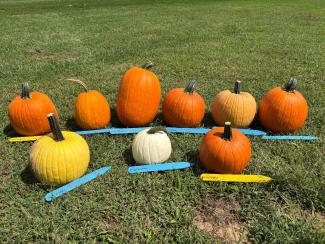
This summer and fall, the Rudolph Lab conducted a pumpkin cultivar trial at the University of Kentucky Horticulture Research Farm. They grew nine Jack o’ lantern cultivars with different shapes, sizes, and colors to observe their growth and development.
Check out below all the pumpkin grown at the farm for inspiration as you choose your own cultivar! Back row, left to right: ‘The Boss’, ‘Rocket’, ‘Early Giant’, ‘Renegade’, ‘Spicy Mocha’, and ‘Kratos’. Front row, left to right: ‘Mellow Yellow’, ‘Ghost Town’, and ‘Racer’.
For information on how to grow your pumpkins and other vegetable crops, please check:
Vegetable Production Guide for Commercial Growers, 2026-28. Available at: https://publications.mgcafe.uky.edu/id-36
Resources for Home Growers: Vegetables. Available at: https://horticulture.mgcafe.uky.edu/growers/home/vegetables
References:
Corry, Sara (2025). Autumn is Pumpkin (and Winter Squash) Time. University of Minnesota Extension. https://extension.umn.edu/about/our-stories/news/autumn-is-pumpkin-and-winter-squash-time.
Kaiser, C. and M. Ernst. (2018). Pumpkins. CCD-CP-114. Lexington, KY: Center for Crop Diversification, University of Kentucky College of Agriculture, Food and Environment. http://www.uky.edu/ccd/sites/www.uky.edu.ccd/files/ pumpkins.pdf
Pumpkins (n.d.). University of Illinois Urbana-Champaign. Illinois Extension. https://extension.illinois.edu/pumpkins
Wright S, Rudolph R, Gauthier N, Bessin R, Leonberger K, Dixon E, Smith H, Lamb A, Kolawole E. 2026. Vegetable production guide for commercial growers, 2026-2028.ID-36. Univ of Kent Coop Ext Serv. Lexington, KY, USA. https://publications.mgcafe.uky.edu/id-36.